Why It Happens Here
Bayonet Point's housing sits a few years ahead of the 1986 median build year across the broader service area - this pocket centers closer to 1979, which puts a meaningful share of its garage doors and hardware into a different generation than what you'd find in the area's newer tracts. That earlier build year means more original extension-spring setups and fewer of the torsion conversions that became standard as the area's housing stock moved into the 1980s and 90s. The mild temperate climate here doesn't put the kind of stress on a door that you'd see in a freeze-thaw region - there's no ice jamming a track - but 46 years of daily heat cycling still does its slow work on steel panels and spring tension. With roughly 11,415 households in Bayonet Point, we're not covering a small pocket, and the age of the stock is consistent enough that this pattern - original door, original springs, original track - comes up on this street as much as the next one.
Where This Job Goes Sideways
The thing that turns a straightforward swap into a longer job is almost always the frame, not the door. A house built in 1979 has had decades for the wood jambs around the opening to dry, shrink, or take on water damage at the base where they meet the slab.
Frame shift and plumb
A new door hangs plumb; an old frame sometimes isn't anymore. We also run into mismatched track widths when a prior owner replaced the door once already with whatever size was in stock at the time, leaving hardware that doesn't match the current opening.
Removed center post
And on the double-door homes, we sometimes find the center post between two single doors was removed at some point to make one wide opening - which changes the header load calculation entirely.
Quote after inspection
None of this is unusual for a neighborhood this age. It just means the quote we give after seeing the opening in person is the one that holds, not the one we'd guess over the phone.
What It Costs
We're not going to put a number here that doesn't hold up once someone's on site, so this section stays on what drives the number rather than the number itself. Size is the first factor - a single 9-by-7 opening costs less to fill than a 16-by-7 double. Material is the second: a basic uninsulated steel door costs less up front than an insulated one, and in Bayonet Point, where median household income runs $42,157 - well under the $62,617 median across the wider service area - we see more homeowners asking for the uninsulated option than you'd find in some of the newer subdivisions further out. That's a reasonable call in this climate; insulation here is about comfort, not survival, since winters stay mild. The honest limitation: if your opening has shifted out of square, you're also paying for new jamb or header work before the door itself goes in, and that's not a cost we can quote until we've seen the frame.
How It Shows Up
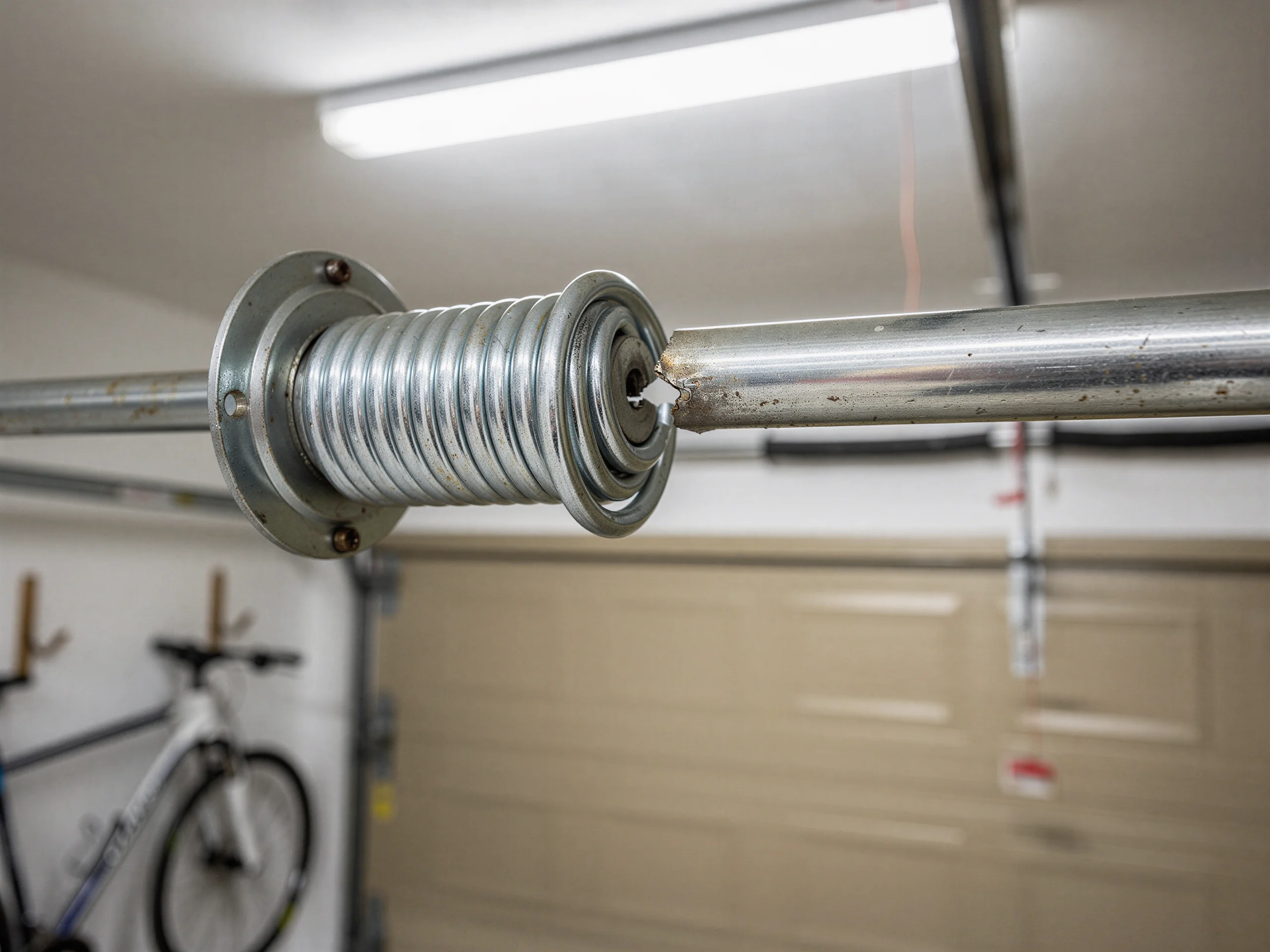
On a house from 1979, the tell is usually the door itself before it's the opener. Original steel panels from that era are thin and uninsulated, and after four and a half decades of expansion and contraction they develop a visible wave across the middle panel, especially on the sun side of the house. Extension springs - the long coiled kind mounted along the horizontal track rather than over the header - are still common on doors this old, and they stretch and rust well before a torsion spring would fail on a newer setup. You'll also see track brackets pulling loose from wood jambs that have dried and shrunk over the years. None of that is dangerous by itself until the day a cable or spring finally lets go, which is usually mid-lift, with the door half up and suddenly heavier than it should be. That's the point where repair stops being the cheaper option and replacement starts making more sense.
Getting It Booked In
We don't keep a truck parked in Bayonet Point. The crew runs out from Land O' Lakes, about 17 miles each way, so booking works best when you can tell us the rough age of the house and whether it's a single or double door opening.
Framed-for-era openings
Most of Bayonet Point went up around 1979, which means the opening itself was framed for a door built to that era's standard - often a 9-by-7 single or a 16-by-7 double, hung on hardware nobody manufactures the same way anymore.
Measure before dispatch
We confirm that measurement before we drive out, not after, because a 46-year-old frame has usually shifted a little and a stock-size door doesn't always drop straight in. Booking is a phone call or a form, a measurement window we set with you, and a written number before any door leaves the shop.
No sight-unseen quotes
We don't quote installs sight-unseen over the phone - too many of these openings have settled enough that the number changes once someone's standing in front of it with a tape measure.
How Long It Takes
A straightforward single-door swap, where the opening measures true and the frame doesn't need work, is usually a one-day job once the door is on the truck. A double door takes a little longer, especially if we're also running new opener wiring or replacing a center post. Where the timeline actually moves is parts - if you want a size or finish we don't carry on the truck, that's an order-in wait before install day, not an install-day delay. We'd rather tell you that up front than promise a date we can't keep. Given the drive from Land O' Lakes, we also batch Bayonet Point jobs where we can, so the measurement visit and the install aren't always back-to-back - we'll tell you that scheduling reality when we book, not after.
Talk to a local pro
Garage door service in Land O' Lakes?
Same-day service with honest, upfront quotes.